Introduction
Transfer learning has revolutionized certain fields, such as computer vision and natural language processing, but reinforcement learning hasn't had the same fortune. One reason is that tasks are generally more specific than images or sentences are. Namely, some ways that tasks differ are in states, actions, reward schemes, and temporal horizons.
To better understand how different state distributions affect multi-task reinforcement learning, we evaluate multi-task policies on tasks that differ only in state distribution. In this work we focus on how the 2015 DQN architecture and some variants handle multi-task learning of Atari games that have visual dissimilarities but are the same in every other way.
We evaluate DQNs on four tasks, each of which is Ms. Pacman with unaltered or transformed states (i.e. frames). The transformations are:
- output = obs (unaltered)
- output = 255 - obs (negative)
- output = sqrt(obs) * sqrt(255)
- output = obs^2 / 255
The figure directly below depicts the transformations. The x-axis is the original pixel intensity, and the y-axis is the transformed pixel intensity.

Part 1: Data Visualization
Imports and functions for Part 1
# PCA t-SNE code adapted from Luuk Derksen
from __future__ import print_function
import time
import os
import numpy as np
import pandas as pd
import cv2
from sklearn.datasets import fetch_openml
from sklearn.decomposition import PCA
from sklearn.manifold import TSNE
%matplotlib inline
import matplotlib.pyplot as plt
from mpl_toolkits.mplot3d import Axes3D
import seaborn as sns
# This loads and returns image data.
def load_data(data_path, is_color=True):
data = [cv2.imread(os.path.join(data_path, f), is_color) for f in os.listdir(data_path) if os.path.isfile(os.path.join(data_path, f))]
data = np.array(data)
img_shape = data[0].shape
return data
# This applies same transformations to data as visual interference experiment does.
def transform_data(data):
data1 = data.astype(np.uint8)
data2 = (255 - data).astype(np.uint8)
data3 = np.floor(np.sqrt(data) * np.sqrt(255.0)).astype(np.uint8)
data4 = np.floor(data ** 2.0 / 255.0).astype(np.uint8)
return data1, data2, data3, data4
Load data, permute, and apply each visual transformation
N = 1000
# Load data and apply same transformations as visual interference experiment does.
data_path = 'mspacman_frames/'
data = np.random.permutation(load_data(data_path))[:N]
data1, data2, data3, data4 = transform_data(data)
data_arr = [data1, data2, data3, data4]
Select random frame and apply each visual transformation
import matplotlib.image as mpimg
data_arr = [data1, data2, data3, data4]
random_idx = np.random.randint(N)
transformed_frames = np.hstack([np.flip(transformed_data[random_idx], axis=-1) for transformed_data in data_arr])
print("Frame {} after transformations 1 (unaltered), 2, 3, and 4 respectively".format(random_idx))
plt.figure(figsize=(20,5))
plt.imshow(transformed_frames)
plt.axis('off')
plt.show()

Visualize data in three ways
We randomly chose 1000 out of 10000 Ms. Pacman frames acquired by running trained policies. We then applied each of the four visual transformations to the 1000 frames to get 4000 frames. We now visualize this 4000 frame collection through the following methods:
- Histogram of pixel intensities for each channel (blue, green, red)
- PCA
- t-SNE with PCA input
Histogram of pixel intensities for each channel (blue, green, red)
The color of the bars matches the color that the channel and intensity correspond to. For example, the bar for 255 for the rightmost column has color (0, 0, 255), which is pure red in BGR channel format.
from matplotlib.colors import LinearSegmentedColormap
n_transforms = 4
n_channels = data1.shape[3]
hist_data = [[[None, None] for j in range(n_channels)] for k in range(n_transforms)]
fig, axes = plt.subplots(nrows=4, ncols=3, sharey='row', figsize=(20, 15))
cmaps = ['Blues', 'Greens', 'Reds']
colors_red = [(0.1, 0, 0), (1, 0, 0)]
colors_green = [(0, 0.1, 0), (0, 1, 0)]
colors_blue = [(0, 0, 0.1), (0, 0, 1)]
colors = [colors_blue, colors_green, colors_red]
n_bin = 255
for transform_num in range(n_transforms):
for channel_num in range(n_channels):
hist_data[transform_num][channel_num] = np.unique(data_arr[transform_num][:, :, :, channel_num], return_counts=True)
cm = LinearSegmentedColormap.from_list('a', colors[channel_num], N=n_bin)
n, bins, patches = axes[transform_num, channel_num].hist(data_arr[transform_num][:, :, :, channel_num].ravel(), bins=15)
bin_centers = 0.5 * (bins[:-1] + bins[1:])
# scale values to interval [0,1]
col = bin_centers - min(bin_centers)
col /= max(col)
for c, p in zip(col, patches):
plt.setp(p, 'facecolor', cm(c))
if channel_num == 0:
axes[transform_num, channel_num].set_ylabel('Transform {}'.format(transform_num), rotation=0, fontsize=25)
axes[transform_num, channel_num].yaxis.set_label_coords(-0.5, 0.45)
if transform_num == 3:
axes[transform_num, channel_num].set_xlabel(cmaps[channel_num], fontsize=25)
axes[transform_num, channel_num].xaxis.set_label_coords(0.5, -0.2)

The different transforms result in distinct intensity counts for both the blue and green channels. The intensities for the red channel are less different, but the PCA plot below shows that frames corresponding to different transformations are still easily separable.
PCA and t-SNE with PCA input
data_reshaped = data.reshape(data.shape[0], -1)
data1_reshaped, data2_reshaped, data3_reshaped, data4_reshaped = transform_data(data_reshaped)
X = np.vstack([data1_reshaped, data2_reshaped, data3_reshaped, data4_reshaped]).astype('float32') / 255.0
num_transforms = int(X.shape[0] / data_reshaped.shape[0])
assert num_transforms == X.shape[0] / data_reshaped.shape[0], "Error: num_transforms must be integer-valued (i.e. decimal part = 0)"
transform = np.vstack([np.full((data1_reshaped.shape[0], 1), i) for i in np.linspace(1, num_transforms, num=num_transforms)])
transform = np.squeeze(transform)
print(X.shape, transform.shape)
# Load data into dataframe for easier plotting later
feat_cols = ['pixel' + str(i) for i in range(X.shape[1])]
df = pd.DataFrame(X, columns=feat_cols)
df['transform'] = transform
df['label'] = df['transform'].apply(lambda i: str(i))
X, y = None, None
print('Size of the dataframe: {}'.format(df.shape))
# t-SNE with PCA input
np.random.seed(0)
rand_perm_idxes = np.random.permutation(df.shape[0])
df_subset = df.loc[rand_perm_idxes[:(N * num_transforms)], :].copy()
data_subset = df_subset[feat_cols].values
pca_n_comp = 2
pca_n = PCA(n_components=pca_n_comp)
pca_result_n = pca_n.fit_transform(data_subset)
df_subset['pca-one'] = pca_result_n[:, 0]
df_subset['pca-two'] = pca_result_n[:, 1]
# df_subset['pca-three'] = pca_result_n[:, 2]
print('Cumulative explained variation for {} principal components: {}'.format(pca_n_comp, np.sum(pca_n.explained_variance_ratio_)))
Because the data is easily separable, just two principal components explain 97% of the variance in the data.
time_start = time.time()
tsne = TSNE(n_components=2, verbose=0, perplexity=40, n_iter=1000, learning_rate=200.0, n_jobs=-1)
tsne_pca_results = tsne.fit_transform(pca_result_n)
print('t-SNE done! Time elapsed: {} seconds'.format(time.time()-time_start))
df_subset['tsne-pca{}-one'.format(pca_n_comp)] = tsne_pca_results[:, 0]
df_subset['tsne-pca{}-two'.format(pca_n_comp)] = tsne_pca_results[:, 1]
plt.figure(figsize=(16,8))
ax1 = plt.subplot(1, 2, 1)
sns.scatterplot(
x="pca-one", y="pca-two",
hue="transform",
palette=sns.color_palette("hls", num_transforms),
data=df_subset,
legend="full",
alpha=0.8,
ax=ax1
)
plt.title('PCA')
# plt.legend([1, 2, 3, 4], title='transform', loc='upper right')
ax3 = plt.subplot(1, 2, 2)
sns.scatterplot(
x='tsne-pca{}-one'.format(pca_n_comp), y='tsne-pca{}-two'.format(pca_n_comp),
hue="transform",
palette=sns.color_palette("hls", num_transforms),
data=df_subset,
legend="full",
alpha=0.8,
ax=ax3
)
plt.title('t-SNE with PCA input')
# plt.legend([1, 2, 3, 4], title='transform', loc='upper right')
plt.show()

All three data visualization techniques show that frames resulting from different visual transformations are easily separable.
Part 2: Experiments and Results
Imports and functions for Part 2
import numpy as np
import pandas as pd
import tensorflow as tf
%matplotlib inline
import matplotlib.pyplot as plt
import seaborn as sns; sns.set()
# Return average clipped rewards as a list
def parse_tf_events_file_avg_clipped_returns(filename):
train_returns = []
for e in tf.train.summary_iterator(filename): # changed from file to filename
for v in e.summary.value:
if v.tag == 'Train_AverageReturnClipped':
train_returns.append(v.simple_value)
return train_returns
# Return average actual rewards as a list
def parse_tf_events_file_avg_actual_returns(filename):
train_returns = []
for e in tf.train.summary_iterator(filename): # changed from file to filename
for v in e.summary.value:
if v.tag == 'Train_AverageReturnActual':
train_returns.append(v.simple_value)
return train_returns
# Reward type: 'clip' or 'actual'
def plot_no_moving_avg(filenames_a, filenames_b, reward_type, timestep_upper_bound=None, title=None, legend=None):
plt.figure(figsize=(30, 10))
for f_a, f_b in zip(filenames_a, filenames_b):
if reward_type == 'clip':
y_tag = 'avg_clipped_return'
avg_return_a = parse_tf_events_file_avg_clipped_returns(f_a)
avg_return_b = parse_tf_events_file_avg_clipped_returns(f_b)
elif reward_type == 'actual':
y_tag = 'avg_actual_return'
avg_return_a = parse_tf_events_file_avg_actual_returns(f_a)
avg_return_b = parse_tf_events_file_avg_actual_returns(f_b)
plt.ylim(0, 2000)
else:
print('Error: invalid reward_type')
if timestep_upper_bound is None:
timestep_upper_bound = min(len(avg_return_a), len(avg_return_b), 500)
timestep = np.arange(timestep_upper_bound) * 5000
df_a = pd.DataFrame()
df_a['timestep'] = timestep
df_a[y_tag] = avg_return_a[:timestep_upper_bound]
df_b = pd.DataFrame()
df_b['timestep'] = timestep
df_b[y_tag] = avg_return_b[:timestep_upper_bound]
result = df_a.append(df_b)
ax = sns.lineplot(x='timestep', y=y_tag, data=result, ci='sd')
if title is not None:
ax.set_title(title, fontdict={'fontsize':30})
if legend is not None:
ax.legend(legend, loc='upper left', fontsize=18)
ax.set_xlabel('timestep', fontdict={'fontsize':20})
ax.set_ylabel(y_tag, fontdict={'fontsize':20})
# Reward type: 'clip' or 'actual'
def plot_moving_avg(all_transform_filenames_1, all_transform_filenames_2_a, all_transform_filenames_2_b, reward_type, n_to_avg=10, timestep_upper_bound=None, titles=None, legends=None):
for transform_filenames_1, transform_filenames_2_a, transform_filenames_2_b, title, legend in zip(all_transform_filenames_1, all_transform_filenames_2_a, all_transform_filenames_2_b, titles, legends):
plt.figure(figsize=(30, 10))
for f_1, f_2_a, f_2_b in zip(transform_filenames_1, transform_filenames_2_a, transform_filenames_2_b):
if reward_type == 'clip':
avg_return_1 = parse_tf_events_file_avg_clipped_returns(f_1)
avg_return_2 = parse_tf_events_file_avg_clipped_returns(f_2_a) + parse_tf_events_file_avg_clipped_returns(f_2_b)
y_tag = 'avg_clipped_return_moving_avg_{}'.format(n_to_avg)
elif reward_type == 'actual':
avg_return_1 = parse_tf_events_file_avg_actual_returns(f_1)
avg_return_2 = parse_tf_events_file_avg_actual_returns(f_2_a) + parse_tf_events_file_avg_actual_returns(f_2_b)
y_tag = 'avg_actual_return_moving_avg_{}'.format(n_to_avg)
else:
print('Error: invalid reward_type')
avg_return_moving_avg_1 = []
avg_return_moving_avg_2 = []
timestep_upper_bound = min(len(avg_return_1), len(avg_return_2))
for i in range(timestep_upper_bound):
avg_return_moving_avg_1.append(np.mean(avg_return_1[(i - 10):i]))
avg_return_moving_avg_2.append(np.mean(avg_return_2[(i - 10):i]))
timestep = np.arange(timestep_upper_bound) * 5000
df_1 = pd.DataFrame()
df_1['timestep'] = timestep
df_1[y_tag] = avg_return_moving_avg_1
df_2 = pd.DataFrame()
df_2['timestep'] = timestep
df_2[y_tag] = avg_return_moving_avg_2
result = df_1.append(df_2)
ax = sns.lineplot(x='timestep', y=y_tag, data=result, ci='sd')
if title is not None:
ax.set_title(title, fontdict={'fontsize':30})
if legend is not None:
ax.legend(legend, loc='upper left', fontsize=18)
ax.set_xlabel('timestep', fontdict={'fontsize':20})
ax.set_ylabel(y_tag, fontdict={'fontsize':20})
Data for Part 2 - 2 indiv, 1 multi
# Fully random sampling
# Transforms 1 and 2
# Seed = 0
filenames_1a = ["data/30-12-2019_05-56-54/DQN_indiv_0_MsPacmanNoFrameskip-v4/events.out.tfevents.1577685428.winter-19-gpu-works-vm",
"data/30-12-2019_05-56-54/DQN_indiv_1_MsPacmanNoFrameskip-v4/events.out.tfevents.1577685428.winter-19-gpu-works-vm",
"data/30-12-2019_05-56-54/DQN_multi_0/indiv_task_0_MsPacmanNoFrameskip-v4/events.out.tfevents.1577685431.winter-19-gpu-works-vm",
"data/30-12-2019_05-56-54/DQN_multi_0/indiv_task_1_MsPacmanNoFrameskip-v4/events.out.tfevents.1577685431.winter-19-gpu-works-vm"]
# Seed = 1
filenames_1b = ["data/30-12-2019_05-56-58/DQN_indiv_0_MsPacmanNoFrameskip-v4/events.out.tfevents.1577685436.winter-19-gpu-works-vm",
"data/30-12-2019_05-56-58/DQN_indiv_1_MsPacmanNoFrameskip-v4/events.out.tfevents.1577685436.winter-19-gpu-works-vm",
"data/30-12-2019_05-56-58/DQN_multi_0/indiv_task_0_MsPacmanNoFrameskip-v4/events.out.tfevents.1577685436.winter-19-gpu-works-vm",
"data/30-12-2019_05-56-58/DQN_multi_0/indiv_task_1_MsPacmanNoFrameskip-v4/events.out.tfevents.1577685436.winter-19-gpu-works-vm"]
# Transforms 1 and 3
# Seed = 0
filenames_2a = ["data/30-12-2019_05-58-10/DQN_indiv_0_MsPacmanNoFrameskip-v4/events.out.tfevents.1577685506.winter-19-gpu-works-vm",
"data/30-12-2019_05-58-10/DQN_indiv_1_MsPacmanNoFrameskip-v4/events.out.tfevents.1577685508.winter-19-gpu-works-vm",
"data/30-12-2019_05-58-10/DQN_multi_0/indiv_task_0_MsPacmanNoFrameskip-v4/events.out.tfevents.1577685509.winter-19-gpu-works-vm",
"data/30-12-2019_05-58-10/DQN_multi_0/indiv_task_1_MsPacmanNoFrameskip-v4/events.out.tfevents.1577685509.winter-19-gpu-works-vm"]
# Seed = 1
filenames_2b = ["data/30-12-2019_05-58-14/DQN_indiv_0_MsPacmanNoFrameskip-v4/events.out.tfevents.1577685514.winter-19-gpu-works-vm",
"data/30-12-2019_05-58-14/DQN_indiv_1_MsPacmanNoFrameskip-v4/events.out.tfevents.1577685514.winter-19-gpu-works-vm",
"data/30-12-2019_05-58-14/DQN_multi_0/indiv_task_0_MsPacmanNoFrameskip-v4/events.out.tfevents.1577685514.winter-19-gpu-works-vm",
"data/30-12-2019_05-58-14/DQN_multi_0/indiv_task_1_MsPacmanNoFrameskip-v4/events.out.tfevents.1577685514.winter-19-gpu-works-vm"]
# Sample batch_size samples per buffer from randomly ordered buffers
# Transforms 1 and 2
# Seed = 0
filenames_3a = ["data/01-01-2020_03-23-50/DQN_indiv_0_MsPacmanNoFrameskip-v4/events.out.tfevents.1577849049.winter-19-gpu-works-vm",
"data/01-01-2020_03-23-50/DQN_indiv_1_MsPacmanNoFrameskip-v4/events.out.tfevents.1577849049.winter-19-gpu-works-vm",
"data/01-01-2020_03-23-50/DQN_multi_0/indiv_task_0_MsPacmanNoFrameskip-v4/events.out.tfevents.1577849048.winter-19-gpu-works-vm",
"data/01-01-2020_03-23-50/DQN_multi_0/indiv_task_1_MsPacmanNoFrameskip-v4/events.out.tfevents.1577849048.winter-19-gpu-works-vm"]
# Seed = 1
filenames_3b = ["data/01-01-2020_03-23-58/DQN_indiv_0_MsPacmanNoFrameskip-v4/events.out.tfevents.1577849051.winter-19-gpu-works-vm",
"data/01-01-2020_03-23-58/DQN_indiv_1_MsPacmanNoFrameskip-v4/events.out.tfevents.1577849052.winter-19-gpu-works-vm",
"data/01-01-2020_03-23-58/DQN_multi_0/indiv_task_0_MsPacmanNoFrameskip-v4/events.out.tfevents.1577849052.winter-19-gpu-works-vm",
"data/01-01-2020_03-23-58/DQN_multi_0/indiv_task_1_MsPacmanNoFrameskip-v4/events.out.tfevents.1577849052.winter-19-gpu-works-vm"]
# Transforms 1 and 3
# Seed = 0
filenames_4a = ["data/01-01-2020_03-35-34/DQN_indiv_0_MsPacmanNoFrameskip-v4/events.out.tfevents.1577849750.winter-19-gpu-works-vm",
"data/01-01-2020_03-35-34/DQN_indiv_1_MsPacmanNoFrameskip-v4/events.out.tfevents.1577849752.winter-19-gpu-works-vm",
"data/01-01-2020_03-35-34/DQN_multi_0/indiv_task_0_MsPacmanNoFrameskip-v4/events.out.tfevents.1577849752.winter-19-gpu-works-vm",
"data/01-01-2020_03-35-34/DQN_multi_0/indiv_task_1_MsPacmanNoFrameskip-v4/events.out.tfevents.1577849752.winter-19-gpu-works-vm"]
# Seed = 1
filenames_4b = ["data/01-01-2020_03-35-55/DQN_indiv_0_MsPacmanNoFrameskip-v4/events.out.tfevents.1577849775.winter-19-gpu-works-vm",
"data/01-01-2020_03-35-55/DQN_indiv_1_MsPacmanNoFrameskip-v4/events.out.tfevents.1577849777.winter-19-gpu-works-vm",
"data/01-01-2020_03-35-55/DQN_multi_0/indiv_task_0_MsPacmanNoFrameskip-v4/events.out.tfevents.1577849777.winter-19-gpu-works-vm",
"data/01-01-2020_03-35-55/DQN_multi_0/indiv_task_1_MsPacmanNoFrameskip-v4/events.out.tfevents.1577849777.winter-19-gpu-works-vm"]
Data for Part 2 - 4 indiv, 4 multi
# Data for run 1 (seed = 0)
transform_1_filenames_1 = ["data/02-01-2020_07-47-56/DQN_indiv_0_MsPacmanNoFrameskip-v4/events.out.tfevents.1577951283.rl-1-vm",
"data/02-01-2020_07-47-56/DQN_multi_0/indiv_task_0_MsPacmanNoFrameskip-v4/events.out.tfevents.1577951327.rl-1-vm",
"data/02-01-2020_07-47-56/DQN_multi_1/indiv_task_0_MsPacmanNoFrameskip-v4/events.out.tfevents.1577951342.rl-1-vm",
"data/02-01-2020_07-47-56/DQN_multi_2/indiv_task_0_MsPacmanNoFrameskip-v4/events.out.tfevents.1577951357.rl-1-vm",
"data/02-01-2020_07-47-56/DQN_multi_3/indiv_task_0_MsPacmanNoFrameskip-v4/events.out.tfevents.1577951372.rl-1-vm"]
transform_2_filenames_1 = ["data/02-01-2020_07-47-56/DQN_indiv_1_MsPacmanNoFrameskip-v4/events.out.tfevents.1577951294.rl-1-vm",
"data/02-01-2020_07-47-56/DQN_multi_0/indiv_task_1_MsPacmanNoFrameskip-v4/events.out.tfevents.1577951327.rl-1-vm",
"data/02-01-2020_07-47-56/DQN_multi_1/indiv_task_1_MsPacmanNoFrameskip-v4/events.out.tfevents.1577951342.rl-1-vm",
"data/02-01-2020_07-47-56/DQN_multi_2/indiv_task_1_MsPacmanNoFrameskip-v4/events.out.tfevents.1577951357.rl-1-vm",
"data/02-01-2020_07-47-56/DQN_multi_3/indiv_task_1_MsPacmanNoFrameskip-v4/events.out.tfevents.1577951372.rl-1-vm"]
transform_3_filenames_1 = ["data/02-01-2020_07-47-56/DQN_indiv_2_MsPacmanNoFrameskip-v4/events.out.tfevents.1577951306.rl-1-vm",
"data/02-01-2020_07-47-56/DQN_multi_0/indiv_task_2_MsPacmanNoFrameskip-v4/events.out.tfevents.1577951327.rl-1-vm",
"data/02-01-2020_07-47-56/DQN_multi_1/indiv_task_2_MsPacmanNoFrameskip-v4/events.out.tfevents.1577951342.rl-1-vm",
"data/02-01-2020_07-47-56/DQN_multi_2/indiv_task_2_MsPacmanNoFrameskip-v4/events.out.tfevents.1577951357.rl-1-vm",
"data/02-01-2020_07-47-56/DQN_multi_3/indiv_task_2_MsPacmanNoFrameskip-v4/events.out.tfevents.1577951372.rl-1-vm"]
transform_4_filenames_1 = ["data/02-01-2020_07-47-56/DQN_indiv_3_MsPacmanNoFrameskip-v4/events.out.tfevents.1577951319.rl-1-vm",
"data/02-01-2020_07-47-56/DQN_multi_0/indiv_task_3_MsPacmanNoFrameskip-v4/events.out.tfevents.1577951327.rl-1-vm",
"data/02-01-2020_07-47-56/DQN_multi_1/indiv_task_3_MsPacmanNoFrameskip-v4/events.out.tfevents.1577951342.rl-1-vm",
"data/02-01-2020_07-47-56/DQN_multi_2/indiv_task_3_MsPacmanNoFrameskip-v4/events.out.tfevents.1577951357.rl-1-vm",
"data/02-01-2020_07-47-56/DQN_multi_3/indiv_task_3_MsPacmanNoFrameskip-v4/events.out.tfevents.1577951372.rl-1-vm"]
# Data for run 2 (seed = 3). There are two parts, a and b, because training stalled and was resumed later.
transform_1_filenames_2_a = ["data/01-01-2020_07-01-14/DQN_indiv_0_MsPacmanNoFrameskip-v4/events.out.tfevents.1577862081.rl-1-vm",
"data/01-01-2020_07-01-14/DQN_multi_0/indiv_task_0_MsPacmanNoFrameskip-v4/events.out.tfevents.1577862127.rl-1-vm",
"data/01-01-2020_07-01-14/DQN_multi_1/indiv_task_0_MsPacmanNoFrameskip-v4/events.out.tfevents.1577862142.rl-1-vm",
"data/01-01-2020_07-01-14/DQN_multi_2/indiv_task_0_MsPacmanNoFrameskip-v4/events.out.tfevents.1577862155.rl-1-vm",
"data/01-01-2020_07-01-14/DQN_multi_3/indiv_task_0_MsPacmanNoFrameskip-v4/events.out.tfevents.1577862173.rl-1-vm"]
transform_2_filenames_2_a = ["data/01-01-2020_07-01-14/DQN_indiv_1_MsPacmanNoFrameskip-v4/events.out.tfevents.1577862090.rl-1-vm",
"data/01-01-2020_07-01-14/DQN_multi_0/indiv_task_1_MsPacmanNoFrameskip-v4/events.out.tfevents.1577862127.rl-1-vm",
"data/01-01-2020_07-01-14/DQN_multi_1/indiv_task_1_MsPacmanNoFrameskip-v4/events.out.tfevents.1577862142.rl-1-vm",
"data/01-01-2020_07-01-14/DQN_multi_2/indiv_task_1_MsPacmanNoFrameskip-v4/events.out.tfevents.1577862155.rl-1-vm",
"data/01-01-2020_07-01-14/DQN_multi_3/indiv_task_1_MsPacmanNoFrameskip-v4/events.out.tfevents.1577862173.rl-1-vm"]
transform_3_filenames_2_a = ["data/01-01-2020_07-01-14/DQN_indiv_2_MsPacmanNoFrameskip-v4/events.out.tfevents.1577862102.rl-1-vm",
"data/01-01-2020_07-01-14/DQN_multi_0/indiv_task_2_MsPacmanNoFrameskip-v4/events.out.tfevents.1577862127.rl-1-vm",
"data/01-01-2020_07-01-14/DQN_multi_1/indiv_task_2_MsPacmanNoFrameskip-v4/events.out.tfevents.1577862142.rl-1-vm",
"data/01-01-2020_07-01-14/DQN_multi_2/indiv_task_2_MsPacmanNoFrameskip-v4/events.out.tfevents.1577862155.rl-1-vm",
"data/01-01-2020_07-01-14/DQN_multi_3/indiv_task_2_MsPacmanNoFrameskip-v4/events.out.tfevents.1577862173.rl-1-vm"]
transform_4_filenames_2_a = ["data/01-01-2020_07-01-14/DQN_indiv_3_MsPacmanNoFrameskip-v4/events.out.tfevents.1577862118.rl-1-vm",
"data/01-01-2020_07-01-14/DQN_multi_0/indiv_task_3_MsPacmanNoFrameskip-v4/events.out.tfevents.1577862127.rl-1-vm",
"data/01-01-2020_07-01-14/DQN_multi_1/indiv_task_3_MsPacmanNoFrameskip-v4/events.out.tfevents.1577862142.rl-1-vm",
"data/01-01-2020_07-01-14/DQN_multi_2/indiv_task_3_MsPacmanNoFrameskip-v4/events.out.tfevents.1577862155.rl-1-vm",
"data/01-01-2020_07-01-14/DQN_multi_3/indiv_task_3_MsPacmanNoFrameskip-v4/events.out.tfevents.1577862173.rl-1-vm"]
transform_1_filenames_2_b = ["data/03-01-2020_20-54-56/DQN_indiv_0_MsPacmanNoFrameskip-v4/events.out.tfevents.1578084911.rl-1-vm",
"data/03-01-2020_20-54-56/DQN_multi_0/indiv_task_0_MsPacmanNoFrameskip-v4/events.out.tfevents.1578084943.rl-1-vm",
"data/03-01-2020_20-54-56/DQN_multi_1/indiv_task_0_MsPacmanNoFrameskip-v4/events.out.tfevents.1578084958.rl-1-vm",
"data/03-01-2020_20-54-56/DQN_multi_2/indiv_task_0_MsPacmanNoFrameskip-v4/events.out.tfevents.1578084974.rl-1-vm",
"data/03-01-2020_20-54-56/DQN_multi_3/indiv_task_0_MsPacmanNoFrameskip-v4/events.out.tfevents.1578084989.rl-1-vm"]
transform_2_filenames_2_b = ["data/03-01-2020_20-54-56/DQN_indiv_1_MsPacmanNoFrameskip-v4/events.out.tfevents.1578084912.rl-1-vm",
"data/03-01-2020_20-54-56/DQN_multi_0/indiv_task_1_MsPacmanNoFrameskip-v4/events.out.tfevents.1578084943.rl-1-vm",
"data/03-01-2020_20-54-56/DQN_multi_1/indiv_task_1_MsPacmanNoFrameskip-v4/events.out.tfevents.1578084958.rl-1-vm",
"data/03-01-2020_20-54-56/DQN_multi_2/indiv_task_1_MsPacmanNoFrameskip-v4/events.out.tfevents.1578084974.rl-1-vm",
"data/03-01-2020_20-54-56/DQN_multi_3/indiv_task_1_MsPacmanNoFrameskip-v4/events.out.tfevents.1578084989.rl-1-vm"]
transform_3_filenames_2_b = ["data/03-01-2020_20-54-56/DQN_indiv_2_MsPacmanNoFrameskip-v4/events.out.tfevents.1578084922.rl-1-vm",
"data/03-01-2020_20-54-56/DQN_multi_0/indiv_task_2_MsPacmanNoFrameskip-v4/events.out.tfevents.1578084943.rl-1-vm",
"data/03-01-2020_20-54-56/DQN_multi_1/indiv_task_2_MsPacmanNoFrameskip-v4/events.out.tfevents.1578084958.rl-1-vm",
"data/03-01-2020_20-54-56/DQN_multi_2/indiv_task_2_MsPacmanNoFrameskip-v4/events.out.tfevents.1578084974.rl-1-vm",
"data/03-01-2020_20-54-56/DQN_multi_3/indiv_task_2_MsPacmanNoFrameskip-v4/events.out.tfevents.1578084989.rl-1-vm"]
transform_4_filenames_2_b = ["data/03-01-2020_20-54-56/DQN_indiv_3_MsPacmanNoFrameskip-v4/events.out.tfevents.1578084933.rl-1-vm",
"data/03-01-2020_20-54-56/DQN_multi_0/indiv_task_3_MsPacmanNoFrameskip-v4/events.out.tfevents.1578084943.rl-1-vm",
"data/03-01-2020_20-54-56/DQN_multi_1/indiv_task_3_MsPacmanNoFrameskip-v4/events.out.tfevents.1578084958.rl-1-vm",
"data/03-01-2020_20-54-56/DQN_multi_2/indiv_task_3_MsPacmanNoFrameskip-v4/events.out.tfevents.1578084974.rl-1-vm",
"data/03-01-2020_20-54-56/DQN_multi_3/indiv_task_3_MsPacmanNoFrameskip-v4/events.out.tfevents.1578084989.rl-1-vm"]
Experiments
We primarily use the DQN architecture from the Nature 2015 paper. In the 4 indiv, 4 multi trials, we investigate how changes to multi-task network architecture affects multi-task learning. We pull from past experience and use hyperparameters that result in consistent learning behavior on Ms. Pacman.
These hyperparameters are:
- discount factor = 0.99
- learning rate = 1e-4
- linear schedule exploration: annealing from 1.0 to 0.01 over the first 500,000 timesteps
- indiv task batch size = 16
- multi task batch size = (# indiv tasks) * (indiv task batch size)
- learning starts at 25,000 samples
- replay buffer size = 50,000
- double DQN
- target net update freq = 5000
Two sample methods are used:
- Sample method 1: Multi-task DQNs sample a random number of samples from each replay buffer, with the constraint that the total number of samples equals (indiv task batch size) * (# of indiv tasks). The full set of samples is permuted before multi-task DQNs train on it.
- Sample method 2: Multi-task DQNs sample indiv_task_batch_size samples from each individual task replay buffer, and only the replay buffer order is randomized.
2 indiv, 1 multi
We evaluate four experiments here:
Using sample method 1,
- Train two individual DQNs, one on transformation 1 (unaltered), and one on transformation 2 (negative). Simultaneously train a single multi-task DQN to perform both of these tasks.
- Train two individual DQNs, one on transformation 1 (unaltered), and one on transformation 3. Simultaneously train a single multi-task DQN to perform both of these tasks.
Using sample method 2,
- Do experiment 1 above
- Do experiment 2 above
4 indiv, 4 multi
We train four individual DQNs, one for each transformation 1, 2, 3, and 4, and simultaneously train four multi-task DQNS to perform all these tasks. To gain insight into how network architecture affects multi-task learning, each multi-task DQN has a different architecture as follows:
- Original DQN architecture. This is depicted directly below
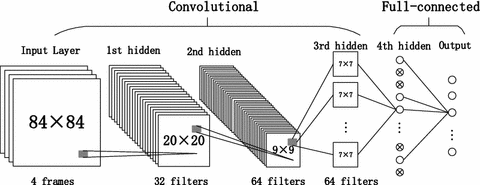
- Original DQN architecture with hidden/conv layer 3 removed.
- Original DQN architecture with additional hidden/conv layer that has 64 output filters, kernel size=(1,1), strides=(1,1), and valid padding added between hidden/conv layer 3 and hidden/fc layer 4.
- Original DQN architecture with hidden/conv layer 3 that has double the output filters as the original (128 vs 64).
Here we use only sample method 2.
All results are averaged over two seeds, and the shaded regions in the following plots represent the standard deviation errors over these seeds. Plots for both clipped and actual rewards are provided. Since rewards are clipped to [-1, +1], clipped and actual rewards strongly correlate with one another. However, clipped rewards have less variance, so the plots representing them may be easier to interpret.
Results
2 indiv, 2 multi
timestep_upper_bound = 230 # manually set to shortest timestep of the following 8 files, which is 230 for 4a and 4b
titles = ['Transforms 1 and 2. Sample method 1.', 'Transforms 1 and 3. Sample method 1.', 'Transforms 1 and 2. Sample method 2.', 'Transforms 1 and 3. Sample method 2.']
legends = [['indiv task 1 on transform 1', 'indiv task 2 on transform 2', 'multi task 1 on transform 1', 'multi task 1 on transform 2'],
['indiv task 1 on transform 1', 'indiv task 3 on transform 3', 'multi task 1 on transform 1', 'multi task 1 on transform 3'],
['indiv task 1 on transform 1', 'indiv task 2 on transform 2', 'multi task 1 on transform 1', 'multi task 1 on transform 2'],
['indiv task 1 on transform 1', 'indiv task 3 on transform 3', 'multi task 1 on transform 1', 'multi task 1 on transform 3']]
all_filenames_a = [filenames_1a, filenames_2a, filenames_3a, filenames_4a]
all_filenames_b = [filenames_1b, filenames_2b, filenames_3b, filenames_4b]
Clipped rewards
for title, legend, filenames_a, filenames_b in zip(titles, legends, all_filenames_a, all_filenames_b):
plot_no_moving_avg(filenames_a, filenames_b, reward_type='clip', timestep_upper_bound=timestep_upper_bound, title=title + ' Clipped rewards.', legend=legend)


Actual rewards
for title, legend, filenames_a, filenames_b in zip(titles, legends, all_filenames_a, all_filenames_b):
plot_no_moving_avg(filenames_a, filenames_b, reward_type='actual', timestep_upper_bound=timestep_upper_bound, title=title + ' Actual rewards.', legend=legend)


We see that the multitask policies trained on transforms 1 and 2 (the more dissimilar pair) generally did worse than those trained on transforms 1 and 3 (the less dissimilar pair).
Continuing trends
We cut off the graphs at 1,150,000 timesteps because that's the length of the shortest run and because a uniform timestep count allows us to quickly compare performances across runs.
However, for every run, the trends above continue for the entire run. For example, here are graphs from experiment 3 for ~2,200,000 timesteps.
plot_no_moving_avg(filenames_3a, filenames_3b, reward_type='clip', timestep_upper_bound=None, title='Transforms 1 and 2. Sample method 1. Clipped rewards. Entire run.', legend=legends[2])
plot_no_moving_avg(filenames_3a, filenames_3b, reward_type='actual', timestep_upper_bound=None, title='Transforms 1 and 2. Sample method 1. Actual rewards. Entire run.', legend=legends[2])


4 indiv, 4 multi
Transforms 1, 2, 3, and 4. Reminder that each multi uses a unique architecture.
Recall that the multi-task agents differ in architecture as described in Experiments - 4 indiv, 4 multi and that only sample method 2 is used for 4 indiv, 4 multi runs.
To more easily interpret the results, we show the moving averages of the 10 most recently averaged returns below.
all_transform_filenames_1 = [transform_1_filenames_1, transform_2_filenames_1, transform_3_filenames_1, transform_4_filenames_1]
all_transform_filenames_2_a = [transform_1_filenames_2_a, transform_2_filenames_2_a, transform_3_filenames_2_a, transform_4_filenames_2_a]
all_transform_filenames_2_b = [transform_1_filenames_2_b, transform_2_filenames_2_b, transform_3_filenames_2_b, transform_4_filenames_2_b]
titles = ['Transform 1. Sample method 2.', 'Transform 2. Sample method 2.', 'Transform 3. Sample method 2.', 'Transform 4. Sample method 2.']
titles_clip = [title + ' Clipped rewards. Moving Average.' for title in titles]
titles_actual = [title + ' Actual rewards. Moving Average.' for title in titles]
legends = [['indiv task 1 on transform 1', 'multi task 1 on transform 1', 'multi task 2 on transform 1', 'multi task 3 on transform 1', 'multi task 4 on transform 1'],
['indiv task 2 on transform 2', 'multi task 1 on transform 2', 'multi task 2 on transform 2', 'multi task 3 on transform 2', 'multi task 4 on transform 2'],
['indiv task 3 on transform 3', 'multi task 1 on transform 3', 'multi task 2 on transform 3', 'multi task 3 on transform 3', 'multi task 4 on transform 3'],
['indiv task 4 on transform 4', 'multi task 1 on transform 4', 'multi task 2 on transform 4', 'multi task 3 on transform 4', 'multi task 4 on transform 4']]
Clipped rewards
plot_moving_avg(all_transform_filenames_1, all_transform_filenames_2_a, all_transform_filenames_2_b, reward_type='clip', n_to_avg=10, titles=titles_clip, legends=legends)


Actual rewards
plot_moving_avg(all_transform_filenames_1, all_transform_filenames_2_a, all_transform_filenames_2_b, reward_type='actual', n_to_avg=10, titles=titles_actual, legends=legends)


We note the relatively large differences in returns between the individual task policies and the multitask policies for Transforms 2 and 4. The multitask policies actually perform the worst on Transform 2, but because the individual task policy for Transform 2 did much worse than that for Transform 4, this is might not be evident at first.
We note that out of Transformations 2, 3, and 4, Transformation 2 results in observations most dissimilar to the original observations as well as to the observations from all transformations collectively. In other words, Transformation 2 is more dissimilar to the other three transformations than any other transformation X is from the three non-X transformations.
Takeaways
- This work supports the notion that multitask policies perform worse on tasks that have observations more dissimilar to the collective set of observations that the multitask policies were trained on, at least if the # of source tasks is small or if there is little overlap in the source task observation distributions.
- No multi-task policy performed even one task as well as the corresponding individual-task policies did even though the multi-task policies trained on 32 or 64 samples per step, 16 from each task, and the individual task policies trained on only 16 samples per step.
- Multi-task policies 2 and 4 consistently did better than 1 and 3. In fact, 2 almost always did the best out of all of the policies, individual and multi-task. The architecture of 2 is the DQN Nature 2015 architecture with the 3rd conv/hidden layer removed, so 2 is the least complex model used in this work. This suggests that simpler models may learn better during early phases of training and may be used to improve sample and wall-clock efficiencies. This also suggests that more complex models overfit early into the training process. We believe this is likely because models see only little data early on, so they are prone to overfitting to this data.
- Multi-task policies 3 and 4 have greater model capacity than 1 and 2 but generally do not perform better than 1 or 2. This indicates that blindly increasing model complexity in RL may not help capture data diversity as much as it generally does in supervised learning.
Part 3: Key Takeaways
- Visual dissimilarities across source tasks can significantly inhibit multi-task learning. In fact, the resulting multi-task policy may not be able to perform any of the source tasks as well as individual task policies do. In this work, no multi-task policies performed even one task as well as the corresponding individual-task policy did even though the sets of task observations between tasks were easily separable and the multi-task policies trained on 2 to 4 times the data that the individual task policies did.
- In this work, greater visual dissimilarities across source tasks resulted in worse performance. Concretely, multi-task policies in the 2 indiv, 1 multi experiment performed worse when trained on Transforms 1 and 2 than when trained on Transforms 1 and 3.
- The least complex multi-task policy performed the best out of the multi-task policies on the 4 indiv, 4 multi runs. This indicates that complex policies are prone to overfitting early into training and that using simpler policies in this regime may improve sample and time efficiencies.
References
Mnih, Volodymyr, Kavukcuoglu, Koray, Silver, David, Rusu, Andrei A, Veness, Joel, Bellemare, Marc G, Graves, Alex, Riedmiller, Martin, Fidjeland, Andreas K, Ostrovski, Georg, Petersen, Stig, Beattie, Charles, Sadik, Amir, Antonoglou, Ioannis, King, Helen, Kumaran, Dharshan, Wierstra, Daan, Legg, Shane, and Hassabis, Demis. Human-level control through deep reinforcement learning. Nature, 518(7540):529–533, 2015.
Appendix
Multithreading Performance
Here we show the wall-clock efficiency improvement of the multithreading approach used in this work over a vanilla sequential implementation. Trials were done using one Tesla K80 per pair of individual task and multi-task DQNs.
def parse_tf_events_file_time(filename):
times_since_start = []
for e in tf.train.summary_iterator(filename): # changed from file to filename
for v in e.summary.value:
if v.tag == 'TimeSinceStart':
times_since_start.append(v.simple_value)
return times_since_start
if __name__=='__main__':
filenames = ['data/06-01-2020_03-57-05/DQN_multi_0/indiv_task_0_MsPacmanNoFrameskip-v4/events.out.tfevents.1578283058.rl-1-vm',
'data/05-01-2020_00-42-58/DQN_multi_1/indiv_task_1_MsPacmanNoFrameskip-v4/events.out.tfevents.1578185022.rl-1-vm',
'data/05-01-2020_03-58-49/DQN_multi_2/indiv_task_2_MsPacmanNoFrameskip-v4/events.out.tfevents.1578196782.rl-1-vm',
'data/05-01-2020_04-15-34/DQN_multi_3/indiv_task_3_MsPacmanNoFrameskip-v4/events.out.tfevents.1578197776.rl-1-vm']
parallel_times = []
for filename in filenames:
times_since_start = parse_tf_events_file_time(filename)
times_to_avg = []
for i in range(len(times_since_start) - 1):
times_to_avg.append(times_since_start[i + 1] - times_since_start[i])
parallel_times.append(np.mean(times_to_avg))
num_agent_pairs = [1, 2, 3, 4]
num_policy_evals = [1, 4, 9, 16]
policy_eval_time = 31
seq_times = []
for batch_multiplier, (i, j) in enumerate(zip(num_agent_pairs, num_policy_evals)):
seq_times.append(i * (parallel_times[0] - policy_eval_time) + j * policy_eval_time * batch_multiplier)
speed_up_factors = []
for i, j in zip(seq_times, parallel_times):
speed_up_factors.append(i / j)
sns.lineplot(x=[1, 2, 3, 4], y=speed_up_factors)
plt.xticks([1, 2, 3, 4])
plt.title('Speed-up factor of this work over vanilla (sequential) implementation')
plt.xlabel('Number of indiv and multi DQNs')
plt.ylabel('Speed-up factor')

Our parallel implementation attains a 4.7x speed-up over a sequential implementation for the 4 indiv, 4 multi runs.